
.png)

AI Can Write Code. It Can’t Guarantee Stability

On the surface, it feels like software development just got dramatically easier.
But many technology leaders are discovering the same pattern:
AI-generated code is not automatically production-ready.
AI can generate code quickly. Turning that code into stable, secure, production software is where the real work begins. Understanding that gap is now critical for organizations deploying AI in real environments.
Industry events and vendor demos often showcase seamless AI workflows: a prompt leads directly to a functional application.
In practice, production environments introduce constraints that demonstrations rarely reflect:
- Legacy infrastructure dependencies
- Security and compliance requirements
- Performance considerations under load
- CI/CD integration
- Observability and monitoring standards
As our CTO, Jason Miller, summarized after evaluating AI tooling at scale:
“There’s a significant distance between what the tooling can generate and what organizations can safely deploy.”
AI-generated code frequently compiles and runs in isolation. That creates a perception of completeness.
Yet production-readiness requires far more than executable output. A production system must demonstrate:
- Architectural consistency
- Security validation
- Integration compatibility
- Data governance alignment
- Performance resilience
In one of our first AI-assisted production deployments, the development process required constant oversight.
“I babysat the AI the entire time. It wasn’t autonomous development — it was supervised engineering.”
This distinction is critical. AI reduces friction in early-stage development, but it does not remove the need for validation, review, and architectural discipline.
This shift becomes clearer when you look at how these systems are structured in practice.
To make this more concrete, here’s an example of how this type of workflow is structured in practice.
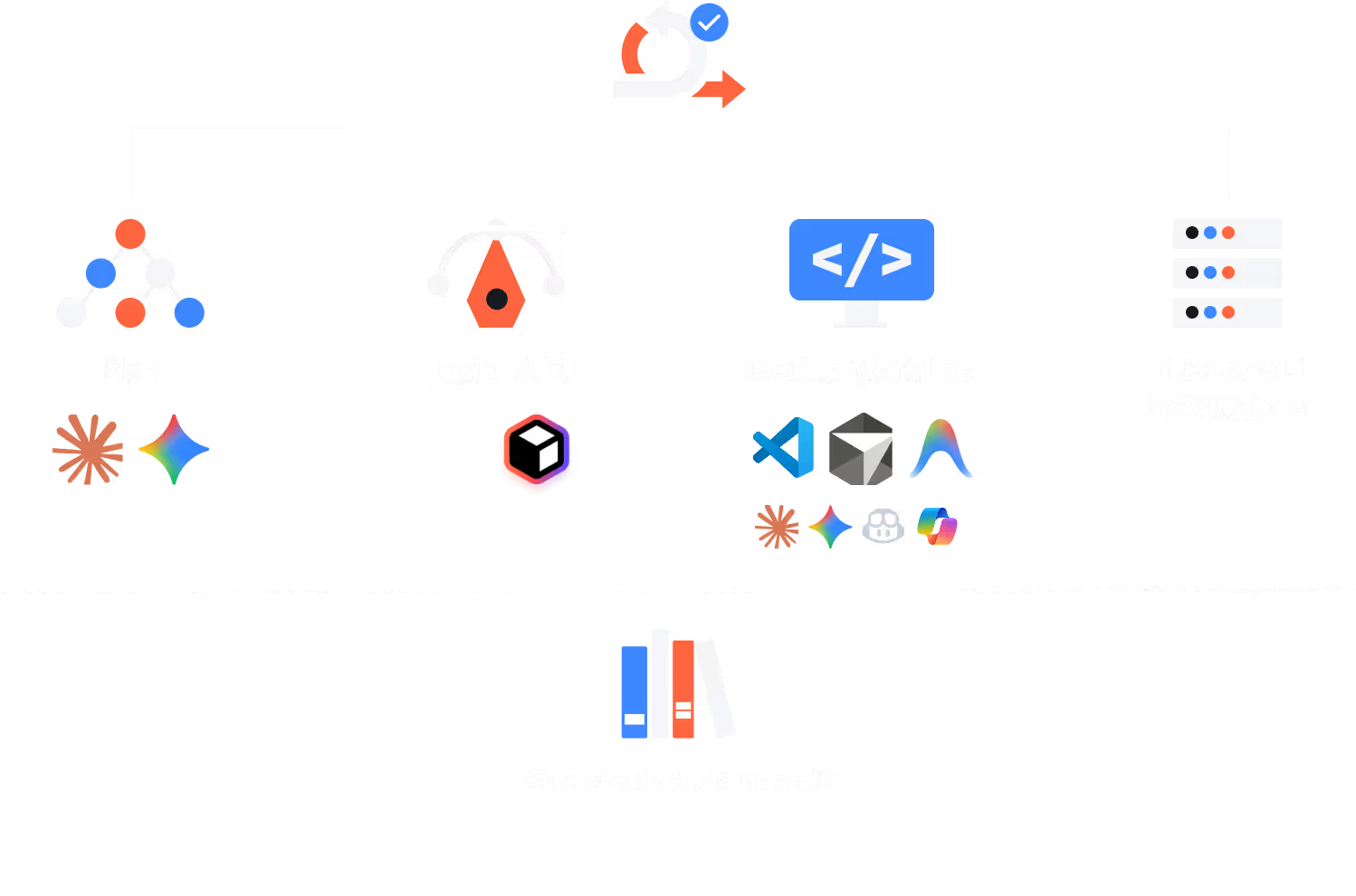
This reflects how AI integrates across the software development lifecycle, from early documentation and design to implementation and system integration.
In this setup, generative AI is not limited to a single step. It supports multiple parts of the process, including documentation, UX and UI design, and code generation.
At the same time, the system is not left unstructured. AI-driven tasks are coordinated through defined workflows, with defined controls to ensure outputs remain consistent with system requirements and constraints.
This includes using task-specific configurations and controlled interactions with existing systems, so generated outputs can move reliably across interconnected systems.
In some cases, a significant portion of the design and implementation can be generated through this approach. What determines success is not the level of automation, but how well that automation is structured and governed.
The most difficult challenge in AI-assisted development is not generating code. It is making the results predictable.
Production software depends on repeatability. Systems must behave consistently across environments, deployments, and updates. AI models, however, are probabilistic systems. Even small changes in prompts, context, or model versions can produce different outputs.
That variability is useful during exploration and experimentation. It becomes problematic when software must be reliable.
This is why many engineering teams are shifting toward spec-driven development in AI workflows. Instead of attempting to generate entire applications in a single prompt, they:
- Break projects into smaller functional units
- Define specifications for each component
- Provide a structured context to the model
- Review outputs incrementally
This approach reduces ambiguity and produces more manageable results.
It is not a new methodology. It is the application of established engineering discipline to AI-enabled development.
AI-generated output often appears confident and complete. However, confidence does not equal correctness.
“The agent will tell you everything works. Sometimes it doesn’t.”
Engineers with deep domain experience can recognize flawed logic, inconsistent architecture, or security gaps immediately. Less experienced practitioners may not.
AI-assisted development does not reduce the need for technical expertise. It increases the importance of it.
The quality of AI output in production is directly correlated with the maturity of the team guiding it.
One of the most common strategic mistakes in AI adoption is treating new AI capabilities as replacements for legacy systems rather than extensions of them.
Organizations often fall into one of two patterns:
- Aggressively layering AI onto fragile infrastructure
- Avoiding AI entirely due to legacy complexity
Neither approach produces sustainable results.
AI initiatives must account for:
- Existing system dependencies
- Data architecture maturity
- Security posture
- Integration pathways
Without integration planning, AI creates friction within existing systems rather than meaningful transformation.
Start With a Short Working Session
Meet the Band of Coders Community